Revolution Rehab: BFR Therapy in Grand Rapids
Physical Therapy, Blood Flow Restriction, Grand Rapids MI
Grand Rapids Blood Flow Restriction: Use BFR to Unlock Systemic Strength
Blood Flow Restriction (BFR) is changing what’s possible in rehab and performance for active adults in Grand Rapids. At Revolution Rehab, it’s not a gimmick—it’s a precise medical tool used to build strength, protect joints, and accelerate recovery when traditional loading isn’t an option.
What Blood Flow Restriction (BFR) Actually Is
Blood Flow Restriction is a training and rehab method where a specialized cuff is placed around the upper arm or upper leg to partially limit venous blood flow while still allowing arterial inflow. You then perform very light resistance exercise—often 20–30% of what you could normally lift—while the cuff is inflated to a carefully calculated pressure using a medical-grade, automated tourniquet system.
The result: your muscles and nervous system experience the session as if you were lifting heavy, even though your joints and healing tissues are under far less stress. That’s the power of BFR when it’s done correctly, in a clinical setting, with precise monitoring.
How BFR Triggers Systemic Growth and Cellular Change
BFR is far more than a “pump.” It creates a powerful internal environment for adaptation across your entire system:
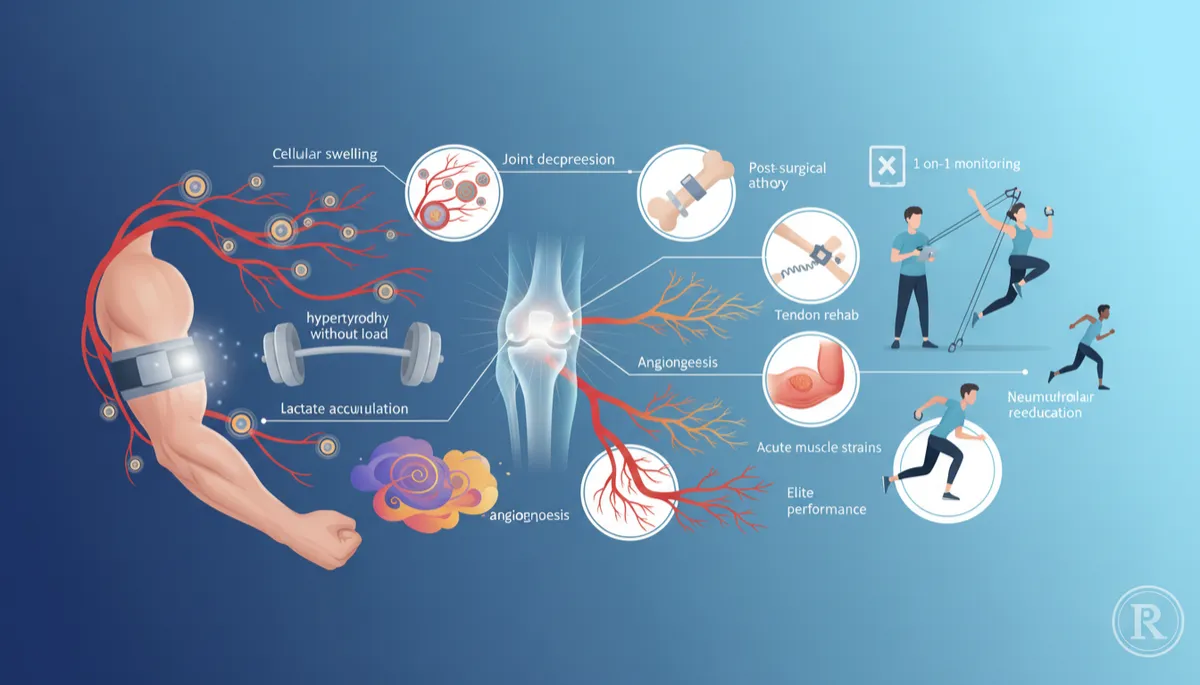
Systemic growth: The temporary restriction and metabolic stress signal your brain and endocrine system to release growth hormone and other anabolic mediators. This systemic growth response supports muscle, tendon, and even bone remodeling throughout the body—not just under the cuff.
Cellular swelling: Fluid shifts into the working muscle cells, creating cellular swelling. This “fullness” is a direct mechanical signal that encourages the muscle to protect itself by growing stronger and thicker over time.
Hypertrophy without heavy load: Because of the metabolic stress and early recruitment of fast-twitch fibers, BFR can drive muscle hypertrophy and strength gains using very low external loads. This is critical when heavy lifting is unsafe or impossible after surgery or injury.
Lactate, Joint Decompression, and Angiogenesis: Why BFR Feels Hard but Heals Smart
Under BFR, your muscles quickly build up lactate and other metabolites. That lactate accumulation is uncomfortable—but it’s also a powerful trigger for hormonal release and muscle adaptation. You get the signal of a brutal heavy session while lifting light weights or even just performing bodyweight movements.
Because the external resistance is low, BFR naturally promotes joint decompression. Your knees, hips, shoulders, and spine aren’t being smashed by heavy loads, yet your muscles are still pushed to meaningful fatigue. This is ideal if you’re dealing with joint irritation, cartilage wear, or joint loading limitations that would normally shut down traditional strength training.
Over time, BFR also encourages angiogenesis—the development of new, more efficient blood vessels. Better microcirculation means improved nutrient delivery, waste removal, and tissue resilience, which matters for long-term joint health, tendon capacity, and endurance performance.

Precise, automated BFR dosing lets you train hard internally while keeping joints protected.
When BFR Is a Game-Changer: From Surgery to Elite Performance
Post-surgical atrophy: After ACL reconstruction, rotator cuff repair, or other surgeries, you often can’t load heavily—but muscle is already wasting away. BFR allows meaningful strength and hypertrophy work with minimal joint load, slowing or reversing atrophy while protecting the surgical site.
Joint loading issues: If you have arthritis, cartilage damage, or joint sensitivity, BFR provides a way to build muscle and capacity around the joint with far less compression and shear. More muscle, less grinding—that’s joint decompression in practice.
Tendon rehab: Tendons respond to time under tension and metabolic stress. BFR lets us load the muscle–tendon unit in a controlled way, stimulating collagen remodeling and capacity without flaring symptoms with heavy loads.
Acute muscle strains: In early phases after a strain, high loads are off the table. BFR allows low-load contractions that maintain strength, circulation, and neuromuscular control while the tissue heals, reducing the slide into full-system deconditioning.
Bone density support: The systemic hormonal response and muscular tension from BFR can support bone density, especially when traditional impact or heavy lifting is limited by pain or surgical precautions.
Elite performance: For runners, golfers, lifters, and competitive adults, BFR is a strategic tool to build capacity during deload weeks, in-season phases, or while training around nagging injuries—so you keep progressing instead of stalling out.
How Revolution Rehab Uses BFR in Grand Rapids, MI
At Revolution Rehab, BFR is never a stand-alone gimmick. It is integrated into our R4 Roadmap—Resolve, Restore, Rebuild, Reimagine—as a strategic tool to accelerate strength and longevity while honoring your healing timeline and long-term goals.
We use medical-grade, automated tourniquet systems that calculate individualized limb occlusion pressure, then set safe, repeatable working pressures. This is not a random elastic band in a gym. It’s a regulated device designed for clinical precision and safety, especially important for post-surgical and medically complex clients.
Every BFR session is 1-on-1 monitored by Dr. Kinch. He tracks your symptoms, pressure settings, exercise selection, and total dose in real time—adjusting based on how your nervous system and tissues respond, not on a cookie-cutter protocol. This is sovereignty, not assembly-line rehab.
BFR + Corrective Exercise + Neuromuscular Re-Education: A Complete System
BFR by itself only changes the “engine.” At Revolution Rehab, we pair it with corrective exercise and neuromuscular re-education so your new strength actually shows up in real life—on the course, on the trail, under the barbell, and chasing your kids around Grand Rapids.
While the cuff drives systemic growth, cellular swelling, and hypertrophy without heavy load, corrective work restores alignment, joint mechanics, and breathing patterns. Neuromuscular re-education then retrains your brain to coordinate that new capacity through the exact movements you care about—running, squatting, swinging, or simply living without guarding and fear.
📌 Key Takeaway: BFR at Revolution Rehab is not about chasing a burn—it’s about building long-term, loadable capacity while protecting your joints and respecting your story.
Take Ownership of Your Health with BFR at Revolution Rehab
If you’re an active adult, runner, golfer, lifter, or busy parent in West Michigan who refuses to settle for quiet physical decline, Blood Flow Restriction may be the leverage point you’ve been missing—especially if surgery, pain, or joint limits have kept you from training the way you want.
Take Ownership Of Your Health. Explore our DIY resources, follow our social channels, and plug into The Life Capacity Matrix Podcast to start reframing how you view your body’s signals. Then, when you’re ready for a precise, individualized plan, book an evaluation at Revolution Rehab with Dr. Kinch for a functional movement and strength screen or long-term custom programming that may include BFR as part of your R4 Roadmap.
Experience what it feels like to stop chasing quick fixes, build real capacity, and use tools like Blood Flow Restriction intentionally—so you can Experience Life on your own terms, now and decades from now.
Book Evaluation HERE